
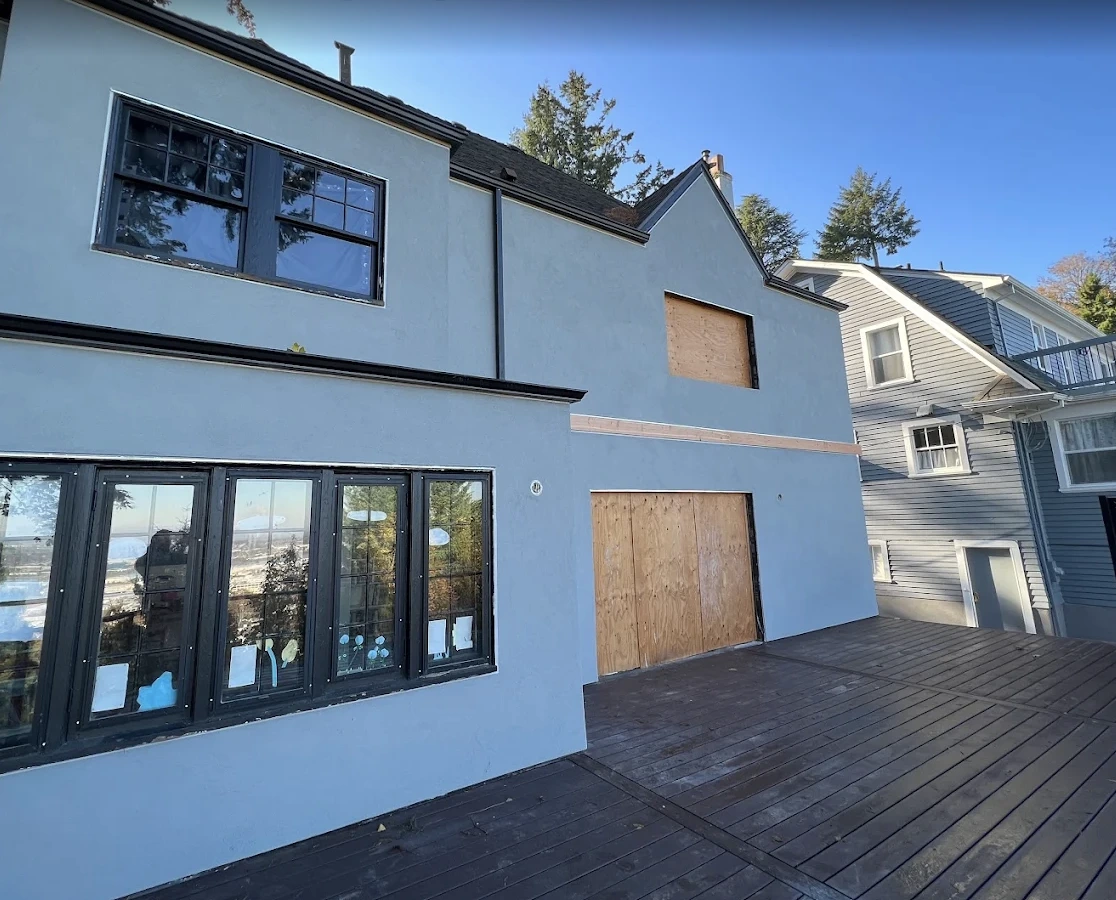
If you are building a new home or replacing an aging exterior in Austin, stucco and vinyl siding are probably both on your list. They serve the same purpose — protecting and finishing the outside of your house — but they differ in nearly every other respect. Here is a practical comparison based on how each material actually performs in Central Texas.
Upfront Cost
Vinyl siding is less expensive to install. Typical vinyl siding in Austin runs $4 to $8 per square foot installed, depending on the grade and profile. Standard stucco installation runs about $8 to $15 per square foot, depending on the system and finish.
For a 2,000-square-foot exterior, that difference adds up: roughly $8,000 to $16,000 for vinyl versus $16,000 to $30,000 for stucco. But upfront cost is only part of the equation.
Durability and Lifespan
This is where stucco pulls ahead significantly. Properly installed stucco lasts 50 to 80 years with minimal maintenance. Vinyl siding lasts 20 to 30 years before it needs replacement.
In Austin's climate specifically, vinyl has additional vulnerabilities. Temperatures regularly exceed 100 degrees, and vinyl siding warps, buckles, and fades under sustained heat and UV exposure. Dark-colored vinyl is especially prone to thermal distortion on south- and west-facing walls. Stucco handles extreme heat well because its cement-based composition has high thermal mass and does not deform.
Hail is another factor. Austin sits in a hail-prone corridor, and vinyl siding dents and cracks on impact. Stucco absorbs hail impact far better — minor dings in the finish are easy to patch, and the underlying wall assembly stays protected.
Maintenance
Vinyl siding is marketed as low-maintenance, and that is mostly true — an annual wash with a garden hose keeps it looking decent. But when vinyl is damaged (a dent, crack, or warped panel), replacing individual pieces requires finding a match in color and profile, which becomes difficult as the siding ages and fades.
Stucco requires occasional inspection for cracks and periodic cleaning. Hairline cracks from normal settling are easy to fill, and the surface can be refinished or painted to refresh the appearance without replacing the material. Stucco maintenance is simple but should not be ignored — catching small cracks early prevents moisture problems.
Energy Efficiency
Stucco provides better thermal performance. A standard three-coat stucco system adds thermal mass to the wall, helping regulate indoor temperatures during Austin's hot days and cool nights. When combined with an EIFS system, stucco delivers continuous insulation with R-values of 4 to 6 or higher.
Vinyl siding has virtually no insulating value on its own. Insulated vinyl siding adds a foam backing that provides R-2 to R-3, which helps but does not match what stucco systems deliver. In a city where air conditioning accounts for a large share of utility bills, this difference matters.
Curb Appeal and Resale Value
Stucco is the dominant exterior finish on higher-value Austin homes, particularly in neighborhoods like Westlake Hills, Barton Creek, and Tarrytown. It offers a seamless, solid appearance with multiple finish textures — smooth, Santa Barbara, dash, lace, and sand — and can be color-matched to virtually any architectural style.
Vinyl siding has improved aesthetically in recent years, but it still reads as a budget material in the Austin market. In neighborhoods where stucco, stone, and Hardie Board are standard, vinyl siding can reduce perceived home value.
According to remodeling cost-versus-value data, stucco exteriors consistently return a higher percentage of their cost at resale compared to vinyl, especially in markets like Austin where buyers expect premium exteriors.
Fire Resistance
Stucco is noncombustible. It earns a one-hour fire rating, meaning it can withstand direct flame exposure for at least 60 minutes before the wall assembly behind it is compromised. In wildfire-prone areas west of Austin — Bee Cave, Lakeway, and the Hill Country — this is a meaningful safety advantage.
Vinyl siding melts and burns. It does not contribute significantly to flame spread, but it offers no fire barrier, and radiant heat from a nearby fire can cause it to warp or ignite.
Which Should You Choose?
Choose **vinyl siding** if upfront cost is your primary constraint and you are in a neighborhood where vinyl is common.
Choose **stucco** if you want a longer-lasting, more energy-efficient exterior that performs well in Austin's heat, hail, and UV conditions — and that adds to your home's resale value.
For most Austin homeowners investing in a 15-plus-year stay, stucco's higher upfront cost pays for itself through durability, energy savings, and resale value.
Get a Free Stucco Estimate
If you are comparing exterior options for your Austin home, contact Star Stucco for a free on-site estimate. We will assess your property and help you understand the cost and timeline for a stucco exterior. Call (512) 706-9699.
Frequently Asked Questions
Is stucco cheaper than vinyl siding?
No. Stucco costs more upfront — typically $8 to $15 per square foot versus $4 to $8 for vinyl. However, stucco lasts 50 to 80 years compared to 20 to 30 for vinyl, so the lifetime cost per year is often lower with stucco.
Does vinyl siding hold up in Austin heat?
Vinyl siding can warp, buckle, and fade under sustained heat and UV exposure. Dark-colored vinyl on south- and west-facing walls is especially vulnerable in Austin summers where temperatures regularly exceed 100 degrees.
Can you put stucco over existing vinyl siding?
It is not recommended. Vinyl siding should be removed before stucco is applied because stucco needs a solid, stable substrate to bond to. The existing sheathing is then prepped with a weather barrier and lath before the stucco system is installed.